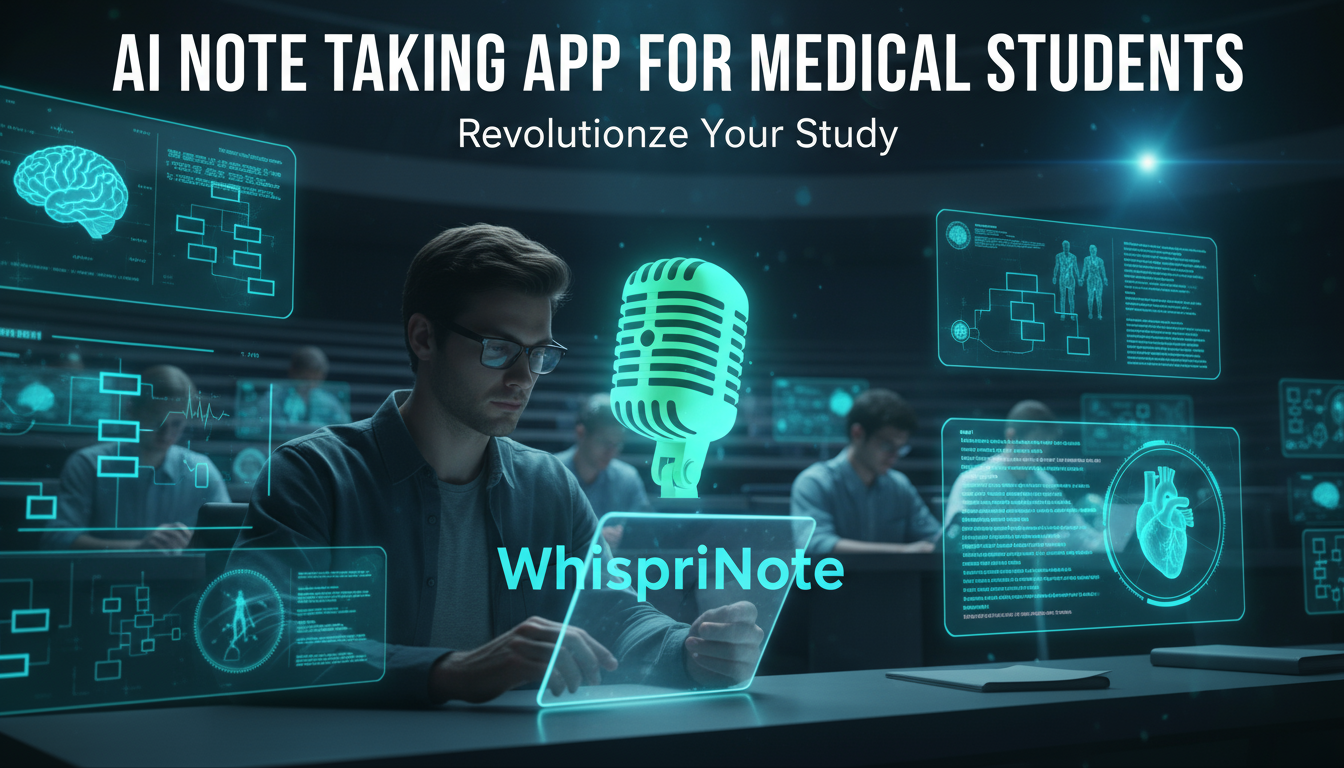
Medical school throws endless lectures at you. Dense pharmacology slides, rapid-fire anatomy sessions, and complex pathophysiology presentations that leave your hand cramping from trying to keep up. You need a better system.
You can get started by turning your medical lectures into organized study materials with WhispriNote.
AI note-taking apps are changing how medical students capture and process information. 45.3% of medical students now prefer AI-powered learning support over their professors, and 42.2% choose it over textbooks. These tools aren't just recording your lectures. They're creating flashcards, generating quizzes, and organizing your notes so you can actually focus on learning instead of scrambling to write everything down.
Let's break down which apps work best for health science students and why.
Why Medical Students Are Turning to AI for Note Taking
Medical education moves fast. You sit through hours of lectures daily, each packed with terms you've never heard and concepts that build on yesterday's material. Traditional note-taking forces you to choose between listening to understand or writing to remember. You can't do both well.
The Numbers Tell the Story
| Metric | Percentage | Source |
|---|---|---|
| Medical students who have used ChatGPT | 48.9% | US Medical Students Study 2024 |
| Students using AI weekly or more | 43.7% | Among ChatGPT users |
| Students who prefer AI over professors | 45.3% | AI Learning Support Survey |
| Students who prefer AI over textbooks | 42.2% | AI Learning Support Survey |
The pattern is clear. Students recognize that AI can handle the mechanical parts of studying while they focus on comprehension.
AI note-taking apps solve a real problem. They transcribe lectures in real time, pull out key concepts, and structure information in ways that make sense for medical education. Stanford Medicine rolled out AI-powered note-taking to all care providers, including medical students, after a successful pilot program. When major teaching hospitals adopt this technology, it signals that AI note-taking has moved from experimental to essential.
How AI Note Taking Improves Exam Performance
The science backs up what students are experiencing. Studies show that participants who used computers to transcribe lectures performed better on delayed recall tests when allowed to study their notes. AI takes this further by organizing information automatically.
Here is why this matters for your exams. Medical licensing exams and board reviews test recall, application, and synthesis. Raw lecture transcripts don't help with any of these. You need notes that highlight relationships between concepts, flag high-yield information, and present material in multiple formats.
Healthcare systems using AI for clinical documentation report a 78% decrease in cognitive load, with 90% of clinicians giving more undivided attention and 86% doing less after-hours work. Time savings translate directly to more study hours or better work-life balance. Both improve your performance.
Top Features to Look For
Not all AI note-taking apps serve medical students equally well. You need specific capabilities that match how health science education works.
Accurate Medical Terminology Recognition
Your app needs to understand "hyponatremia" and "bradycardia" without turning them into gibberish. Medical vocabulary is specialized. Generic transcription tools miss clinical terms or create dangerous errors. Look for apps trained on medical content.
Multi-Format Input Support
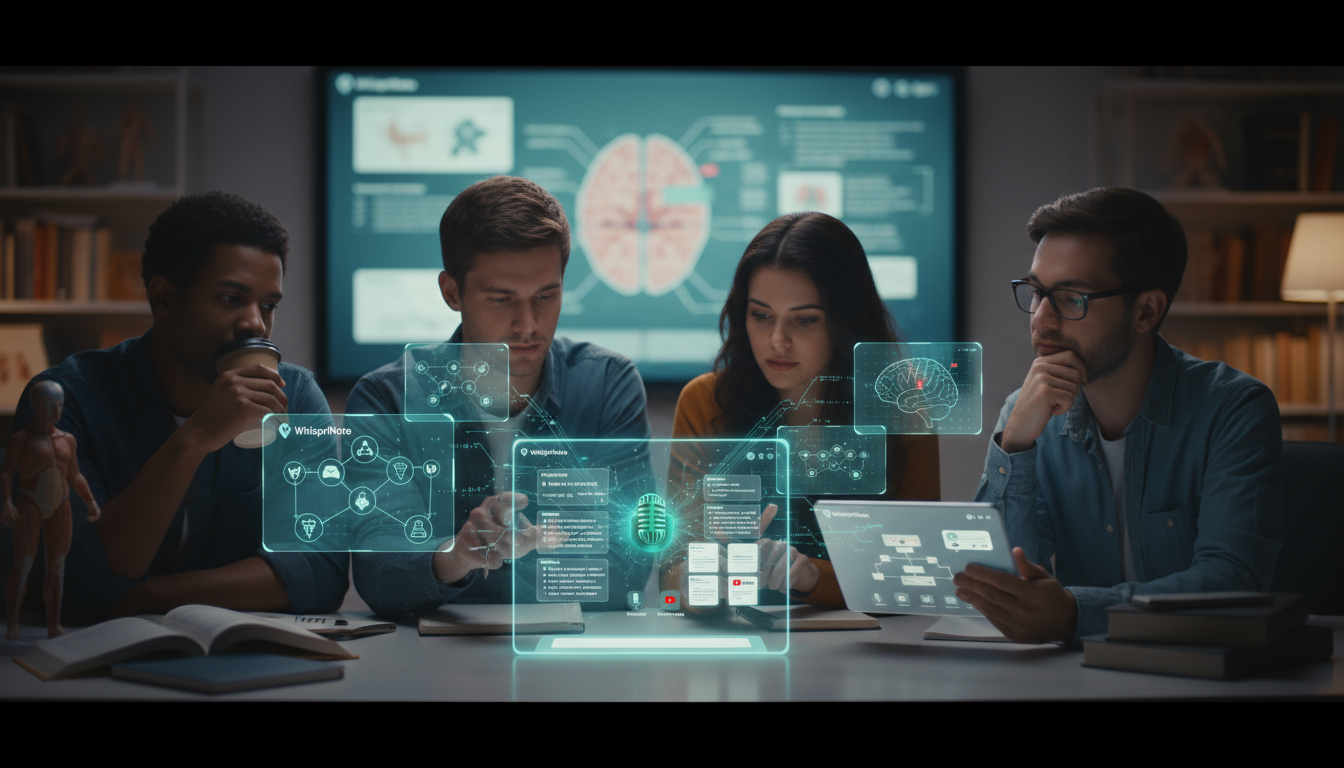
You learn from live lectures, recorded sessions, PDFs of slides, textbook chapters, and even educational YouTube videos. Your note-taking system should handle all of these. Apps like WhispriNote can process audio recordings and YouTube video URLs, turning them all into one unified set of study notes.
Automatic Summarization
Hour-long lectures contain maybe 20 minutes of essential information. AI should identify key points and create structured notes-not just summaries, but organized outlines with key takeaways. This lets you review faster and focus on what matters for exams.
Flashcard and Quiz Generation
37.5% and 41.3% of medical students report using ChatGPT for summarizing. The best apps go further by automatically creating study tools from your notes. Look for tools that generate visual diagrams, flowcharts, and mind maps to help you visualize complex processes. Some, like WhispriNote, even include a voice chat feature, allowing you to "talk" to your notes, ask questions, and quiz yourself on the material.

WhispriNote: Integration with Study Systems
WhispriNote combines high-quality transcription with smart note generation. Record once. Get organized notes with summaries, diagrams, and review questions.
Available on:
- iOS App - Convert videos from your iPhone or iPad
- Android App - Full functionality on any Android device
- Web Platform - Access from any browser
Automatic Transcription: Record lectures and get accurate transcripts quickly.
AI-Powered Summaries: Turn raw audio into structured study notes with key points extracted.
Visual Learning: Generate flowcharts and mind maps automatically to clarify complex topics.
YouTube Integration: Process educational videos into study notes. Perfect for Khan Academy tutorials, crash courses, or conference talks. Try the free YouTube to Notes page.